
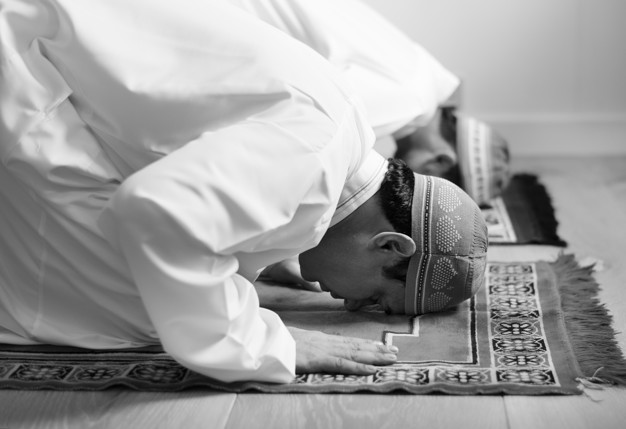
How to Perform the Prayer
Each prayer is made up of a different number of units (rak‘ahs). The following steps are the elements that each prayer has to contain:
- Stand facing the Qibla.
- Make the intention for prayer in the heart as mentioned above. This is done simultaneously with the takbīratu’l–ihram (see below). Before a Muslim starts to pray, it is important for them to make an intention. This involves either saying or thinking that they are going to perform whatever prayer they intend to perform facing the qibla for the sake of God. For example before praying Fajr a Muslim might say in Arabic: ‘Nawaytu uṣalli al-Fajr’ (I intend to perform the Fajr prayer).
- Look at the place where your head will rest during prostration and raise your hands to the level of your shoulders and say, Allahu akbar (God is the Greatest). This is takbīratu’l–ihram.
- Recite Du‘ā al-Istiftāḥ which is transmitted in various versions. The easiest one is:Stand upright. In the case of an able-bodied person, leaning over until it is deemed not to be standing upright invalidates prayer. If one is incapable of standing, however, he may sit, lie on his right, lie on his left, lie on his back or take any position he is able to take.
- Put your right hand over your left hand and wrist and place them on chest.[1]
سبحانك اللهم وبحمدك وتبارك اسمك وتعالى جدك ولا إله غيرك
‘Subhānaka Allahumma wabiḥamdik, watabāraka ismuka, wa ta’āla jadduka wala ilāha ghayruk.’
‘Glory be to you, O Allah, and all praises are due unto You, and blessed is Your name and high is Your majesty and none is worthy of worship but you.’ [Abu Dawūd]
- Recite al-Fātiḥa. The recitation of al-Fātiḥa is obligatory in every rak‘ah:
﴿بِسْمِ اللَّهِ الرَّحْمَنِ الرَّحِيمِ ، الْحَمْدُ لِلَّهِ رَبِّ الْعَالَمِينَ ، الرَّحْمَنِ الرَّحِيمِ ، مَالِكِ يَوْمِ الدِّينِ، إِيَّاكَ نَعْبُدُ وَإِيَّاكَ نَسْتَعِينُ ، اهدِنَا الصِّرَاطَ الْمُسْتَقِيمَ ، صِرَاطَ الَّذِينَ أَنْعَمْتَ عَلَيْهِمْ غَيْرِ الْمَغْضُوبِ عَلَيْهِمْ وَلاَ الضَّالِّينَ﴾
‘Audhdu billāhi min ash-shaytānir rajīm, bismillāhi’r-raḥmāni’r-raḥīm, alḥamdulillāhi rabbi’l-‘ālamīn, ar-raḥmāni’r-raḥīm, maliki yawmi’d-dīn, iyyāka na’budu wa iyyāka nasta’īn, ihdina’ṣ–ṣirata’l-mustaqīm, sirata’ladhina an’amta ‘alayhim, ghayri’l-maghdūbi ‘alayhim, wala’d-dāllīn. Amīn Qaa
‘Praise is only for God, Lord of the Universe. The Most Kind, the Most Merciful. The Master of the Day of Judgment. You alone we worship and to You alone we pray for help. Show us the Straight Way, the way of those whom You have blessed. Who have not deserved Your anger, nor gone astray.’ Ameen
- Then, recite another short sūrah or any other easy verses of the Qur’an after al-Fātiḥa in the first two rak‘ahs only.
- Go into rukū’. Rukū’ is bowing the body so that the back is parallel to the ground and the palms are on the knees. When in rukū’ say: subḥana rabbiya al-‘adhīm wa biḥamdih (Glory to my Lord, the Most Magnificent, Most Praiseworthy) three times.
Stand up again after rukū’. While the body is returning to the upright position say: sami’a’Llahu liman hamidah (God Listens to the one who praises Him). You can add: rabbana laka’l-ḥamd (Our Lord, to You is due all praise).
- Go into sujūd (prostration). Sujūd entails placing the bare forehead, the palms, the knees and the toes bent forwards, on the ground. When in sujūd say: subḥana rabbiya’l-a’la wa biḥamdihi (Glory to my Lord, the Most High, Most Praiseworthy). (3 times)
- During the sitting between the two prostrations, say: Allahumma ighfir lī (O Allah, forgive my sins).
Sit back on both feet in a kneeling position.
- Go into sujūd (prostration) a second time. When in sujūd say: subḥana rabbiya’l-a’la wa biḥamdihi (Glory to my Lord, the Most High, Most Praiseworthy).
- Then stand up for the second rak‘ah (unit) and repeat what you did in the first.
- After the second prostration in the second rak‘ah sit back on both feet in a kneeling position and recite the first following part of the Tashahhud:
التَّحِيَّاتُ لِلَّهِ ، وَالصَّلَوَاتُ وَالطَّيِّبَاتُ ، السَّلَامُ عَلَيْكَ أَيُّهَا النَّبِيُّ وَرَحْمَةُ اللَّهِ وَبَرَكَاتُهُ ، السَّلَامُ عَلَيْنَا وَعَلَى عِبَادِ اللَّهِ الصَّالِحِينَ ، أَشْهَدُ أَنْ لَا إِلَهَ إِلَّا اللَّهُ ، وَأَشْهَدُ أَنَّ مُحَمَّدًا عَبْدُهُ وَرَسُولُهُ .رواه البخاري
At-tahiyyātu lillahi wa’ṣ–ṣalawātu wa’t-tayyibātu, as-salāmu ‘alayka ayyuha’n-nabiyyu wa raḥmatullahi wa barakātuhu, assālamu ‘alayna wa’alā ‘ibadi’Llahi’ṣ–ṣālihin, ash-hadu alla ilāha illa’Llahu wa ash-hadu anna Muhammadan abduhu wa rasūluh.
This means: ‘Greetings, prayers and goodness belong to God. Peace be on you, O Prophet and the mercy of God and His blessings. Peace be on us and on the righteous servants of God. I bear witness that there is no god but God and I bear witness that Muhammad is His servant and Messenger.
- This completes the two rak‘ah
- In Maghrib, Ẓuhr, ‘Asr, and ’Ishā’, you stand up to complete the prayer after you have done the above tashahhud and the whole procedure is repeated in the remaining rak‘ahs. You say ‘Allahu akbar’ when standing up and, in the remaining rak‘ahs, only recite al-Fātiḥa with no other sūrah. Then you continue doing the rest of the actions you did in the first two rak‘ahs [rukū’, rising, sujūd twice] and then stand up again in the case of the four rak‘ah prayers. At the end of the prayer you remain seated and, after the first part of the tashahhud you say the second part called aṣ–ṣalāta’l-Ibrahimiya’:
[اللَّهُمَّ صَلِّ عَلَى مُحَمَّدٍ، وَعَلَى آلِ مُحَمَّدٍ، كَمَا صَلَّيْتَ عَلَى إِبْرَاهِيمَ وَعَلَى آلِ إِبْرَاهِيمَ، إِنَّكَ حَمِيدٌ مَجِيدٌ ، اللَّهُمَّ بَارِكْ عَلَى مُحَمَّدٍ، وَعَلَى آلِ مُحَمَّدٍ، كَمَا بَارَكْتَ عَلَى إِبْرَاهِيمَ، وَعَلَى آلِ إِبْرَاهِيمَ إِنَّكَ حَمِيدٌ مَجِيدٌ] رواه البخاري
Allahumma ṣalli ‘alā Muhammad wa ‘alā āli Muhammad kamā ṣallayta ‘alā Ibrāhīm wa ‘alā āli Ibrāhīm, innaka hamīdun majīd, Allahumma bārik ‘alā Muhammad wa ‘alā āli Muhammad kama bārakta ‘alā Ibrāhima wa ‘alā āli Ibrāhima fi’l-‘ālamīna innaka hamidun majīd.
O God, let Your mercy come upon Muhammad and the family of Muhammad as You let it come upon Ibrahim and the family of Ibrahim. O God, bless Muhammad and the family of Muhammad as You blessed Ibrahim and the family of Ibrahim. Truly You are Praiseworthy and Glorious.[2]
- Recitation of the Qur’an during the prayer. During the obligatory Fajr prayer, you recite the Qur’an aloud in both rak‘ahs. You also recite aloud in the first two rak‘ahs of the obligatory prayers of Maghrib and ‘Ishā’ but the third and fourth rak‘ahs of those prayers are recited silently. In the Ẓuhr and ’Asr prayer the recitation is silent in all four rak‘ahs. The recitation of the Imam in the Jumu‘ah prayer [the Friday prayer in place of Ẓuhr] is also out loud.The Taslīm (Greeting): Say, as-salāmu alaykum waraḥmatu’Llah (peace be upon you and God’s mercy) while turning your head to the right. Then, say it again while turning your head to the left.
- Following the correct sequence during the prayer. If the correct sequence of movements is not followed the prayer is invalidated.
[1] Scholars mention various narrations about the position of hands. Some view the hands should be under the navel, others view it above, and Malik views it as not necessary. The authentic tradition refers that it should be above the navel on the chest.
[2] There are other wording and narrations for Tashshahud which are also authentic.
