
Childhood
- Muhammad was the son of Abdullah, who was the son of Abdul-Muttalib, who was the son of Hashim; whose ancestry reaches Prophet Ismael son of the Prophet Abraham.
- Muhammad was born in the city of Makkah, in Arabia, on a Friday, the 17th day of the lunar month of Rabi‘ al-Awwal, in the year 570 CE into a noble family whose fathers and ancestors were amongst the chiefs of the Quraysh tribe, and the Bani-Hashim clan.
- His father, Abdullah Ibn Abdul-Muttalib, died before his birth.
- His mother, Aminah daughter of Wahb, died of illness when he was six years old.
- As an orphan, Muhammad was sent to be raised by his grandfather, who died two years later.
- Finally, he passed to the care of Abu Talib, his paternal uncle.
Personal Character
- In early age, Muhammad worked as a shepherd, and later as an apprentice trader for his uncle.
- As he grew, Muhammad gained a reputation for thoughtfulness and integrity. People nicknamed him Al-Sadiq (The Truthful), because he never told a lie; and Al-Amin (The Trustworthy), because he never cheated. He was called upon frequently to mediate disputes between the people of Makkah.
- When he was 25 years old, Khadijah bint Khuwaylid, a 40-year-old Makkah widow known for her strong character and successful trading business, proposed to him. They married in the year 595 AD (28 BH).
- Muhammad was also known for his disdain of the pagan culture that predominated among the people of Makkah. He never worshipped the idols of Quraysh, the tribe to which he belonged. Instead, he made long retreats to a mountain cave called Hira’, outside of Makkah, where he meditated.
Meeting Bahira, the Monk
- When the Messenger of God [Pbuh] was twelve years old, he went with his uncle Abu Talib on a business journey to Syria. When they reached there, they met a monk called Bahira [his real name was Georges], who showed great kindness, and entertained them lavishly. He had never been in the habit of receiving or entertaining them before.
- Bahira readily enough recognized the Prophet [Pbuh] and said while taking his hand: ‘he will be a great personality over all humans. He adds, I can recognize him also by the seal of Prophethood which is below his shoulder, like an apple. We have got to learn this from our books.’
Revelation
- When he was 40, while in solitude at Hira’, Muhammad experienced the first incident of revelation. He said the Angel Gabriel came to him and instructed him in the following words, which later became known as the first revealed verses of the Qur’an: ‘Read! In the name of your Lord, Who created, Created man, out of a mere clot of congealed blood. Proclaim! and you Lord is Most Bountiful, He Who taught man the use of pen, taught man that which he knew not.’ (96:1-5)
- Muhammad’s reaction to this experience was fear and shock. He returned home and was comforted by Khadijah, who later became the first believer in his message.
- In the following years, the Angel Gabriel instructed Muhammad to take the words of the Qur’an to the public.
- Makkah, at that time, was a centre for trade and idol worship in Arabia. This made it a city of considerable prestige and wealth. The city’s leaders feared Muhammad’s monotheistic message would jeopardize this status.
Teachings
- Muhammad led a humble life, never distinguishing himself from the common person–he had no body guards, and moved without an entourage. He told people that his job as a messenger of God was simply to reaffirm what God had already revealed to humanity through previous prophets, including Adam, Abraham, Moses, and Jesus.
- In the monotheistic worldview, God created humankind as dignified creatures endowed with free will. Men and women are entrusted with leading a life of goodness, in the hope of reaping the ultimate benefits in the next life. Although no single verse summarizes all the teachings of Islam, the following excerpts from the Qur’an represent the Straight Path God has chosen for believers:
‘Say: ‘Come let me recite to you what your Lord Has forbade for you: that you should not set-up anything [for the sake of worship] with Him; and be kind to your parents; and do not kill your unborn children for fear of poverty, We provide for you and for them; and do not come near evil, what is openly of it, or secretly; and do not kill the soul which God has forbidden, except in justice; and do not come near the money of the orphan, except for what is best, until he reached his maturity; and give honestly full-measure and weight equitably—we do not burden a soul except by what it can bear; and if you speak, then be just, even if against a relative; and with pledges made to God you shall observe. This He Has enjoined you that you may remember; And this is My path, a Straight One, so you shall follow it, and do not follow the other paths lest they divert you from His path. That is what He has enjoined you to that you may be righteous.’ (6:151-153) - The poor, the oppressed and women were among the early believers in Islam. The Qur’an declared equality as a universal value that applied to all. Additionally, the Qur’an prohibited Makkah’s unacceptable pagan practices, such as female infanticide, and encouraged freeing slaves. Muhammad taught that there should be no distinction between Arabs and non-Arabs, or between Whites and Blacks. Muhammad said all humans are the same in the sight of God.
Persecution
- The stunning rhythm and depth of content contained in the Qur’an’s verses captured the attention of even the most eloquent Arabs.
- Makkah’s pagans disparaged Muhammad as a mere poet, but the Muslims believed in the Qur’an as the ultimate miracle of the faith; a testimony in support of Muhammad’s prophethood. The early Muslims cherished the verses, memorized them, wrote them down, and struggled to live by them. The pagans of Makkah ridiculed Muhammad’s claim to prophethood, and rejected his teachings.
- For the next decade, Muhammad and early Muslims were subjected to inhumane treatment. Muslims were killed, tortured and boycotted; their property was taken by force.
- In response, Muhammad encouraged his followers to migrate to neighbouring cities and states. He told them Christian Abyssinia (today’s Ethiopia) would offer a good refuge because it was ruled by a just king.
- Muhammad tried to take his message outside Makkah. He went to a nearby mountain town called Tai’f, but leaders there sent their youth to throw stones at Muhammad until, after suffering considerable physical injury, he left.
Trials and Tragedies
- In a period of troubles, trials and tribulations two major tragedies afflicted Muhammad. First the venerable guardian uncle Abu Talib died and shortly afterwards his noble wife Khadijah died, leaving behind her daughter Fatimah – the only child she had from the Prophet – the daughter who looked after her father.
The Makkan period can be summarized in four stages:
- The first stage began with his appointment as a Messenger and ended with the proclamation of Prophethood three years later. During this period the Message was given secretly to some selected persons only but the common people of Makkah were not aware of it.
- The second stage lasted for two years after the proclamation of his Prophethood. It began with opposition by individuals: then it took the shape of antagonism, ridicule, derision, accusation, abuse and false propaganda then gangs were formed to persecute those Muslims who were comparatively poor, weak and helpless.
- The third stage lasted for about six years from the beginning of the persecution to the death of Abu Talib and Khadijah in the tenth year of Prophethood. During this period the persecution of the Muslims became so savage and brutal that many of them were forced to migrate to Abyssinia while social and economic boycott was applied against the remaining Believers.
- The fourth stage lasted for about three years from the tenth to the thirteenth year of Prophethood. This was a period of hard trials and grievous sufferings for the Prophet and his followers. Life had become unendurable at Makkah and there appeared to be no place of refuge even outside it. So much so that when the Prophet went to Ta’if, it offered no shelter or protection.
- Moreover, on the occasion of Hajj, he would appeal to each and every Arab clan to accept his invitation to Islam but was met with blank refusal from every quarter. At the same time, the people of Makkah were holding counsels to get rid of him by killing or imprisoning or banishing him from their city. It was at that most critical time that God opened for Islam the hearts of the People of Yathrib where he migrated at their invitation.
Migration
- Muhammad’s hardships mounted when his uncle Abu Talib passed away, leaving him without a strong ally in Makkah.
- Soon after his uncle’s death, he was secretly visited by leaders of the two major tribes of Madinah, a town 300 miles to the northeast of Makkah. The leaders, whose tribesmen fought one another in lengthy wars, converted to Islam and invited Muhammad and the Makkah Muslims to live in Madinah.
- The Makkah Muslims left their homes gradually. Their departure was soon discovered by the leaders of Quraysh, who decided to eliminate Muhammad, the last to leave. But on the night they were to kill him, Muhammad escaped with his closest friend Abu Bakr.
- In Madinah, safe from Makkah persecution, Muhammad was now free to call others to Islam, and his followers increased rapidly. To Muslims, he was both a messenger of God who shared with them divine revelation, and a political leader who governed their public affairs.
- Under the guidance of Muhammad, the Charter of Madinah was developed. Some people argue that the Charter was the first pluralistic constitutional framework known to mankind. Not only did it recognize the several tribes engaging in free trade inside and outside Madinah, it also acknowledged Jewish tribes as a collective entity bonded with Muslims through attachment to a system of rights and obligations. The Charter of Madinah created an environment where all could lead a moral life and band together to oppose aggression of any sort.
- Makkah’s leadership attempted to prevent Muhammad’s movement from taking root in Madinah. They organized military expeditions against the city, but were eventually beaten back.
Spread of Islam
- Forced to recognize that they could not eliminate Islam or defeat the Muslims, the pagans of Makkah concluded the Treaty of Hudaybiyah with the Muslims, agreeing to maintain peace and to observe neutrality in their conflicts with third parties.
- Effectively, the treaty recognized Muslims as a new force in Arabia and acknowledged their freedom to move unmolested throughout the region. In the months of tranquillity that followed Muslims sent preachers in all directions; many people and tribes in Arabia converted to Islam.
- In 630 AD (8 AH) Makkah allies breached the treaty when they massacred a group of traveling Muslims.
- Following the attack, Muslims gathered in Madinah in great numbers. This army then marched on Makkah. The numbers and dedication of Muslims stunned the leaders of the city. They decided not to fight.
- Entering Makkah, Muhammad gave amnesty to all people who did not want to fight, and so stayed inside their homes. Except for few minor incidents, the opening of Makkah was one of the most astonishingly bloodless military victories in world history.
- The people of Makkah, who had relentlessly oppressed Muhammad and his followers for more than two decades, feared retribution. However, they were treated with the greatest magnanimity. In a grand public gathering at the town centre, Muhammad asked them, ‘What do you think I will do with you?’ ‘You are kind, and the son of a kind brother,’ their leaders answered. ‘Go, you are free!’ Muhammad replied. The Muslims understood these words to mean total forgiveness. No home was pillaged; no property was confiscated.
- Over the years, the pagan Makkah converted to Islam. The Prophet removed all the idols in and around the Ka’ba, the cubic monument at the centre of the city believed to have been built by Abraham and his son Ishmael. Ever since, the Muslim call to prayer has been heard five times a day in this ancient sanctuary.
His Last Years
- Muhammad returned to Madinah, which continued to be the political capital of the Islamic city-state. In 632 AD (10 AH) Muhammad went to Makkah as a pilgrim, believing it was for the last time. The revelation he received there included the verse ‘Today I have perfected your religion for you, and completed My favour to you.’ (5:3).
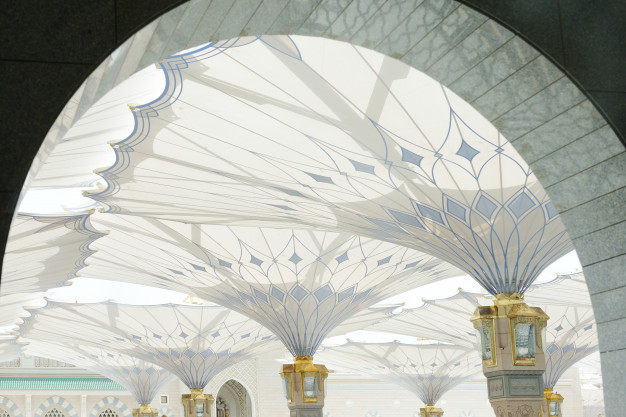
- A few months after returning to Madinah, Muhammad died after a brief illness. He is buried in the grand Prophet’s Mosque in Madinah.
