
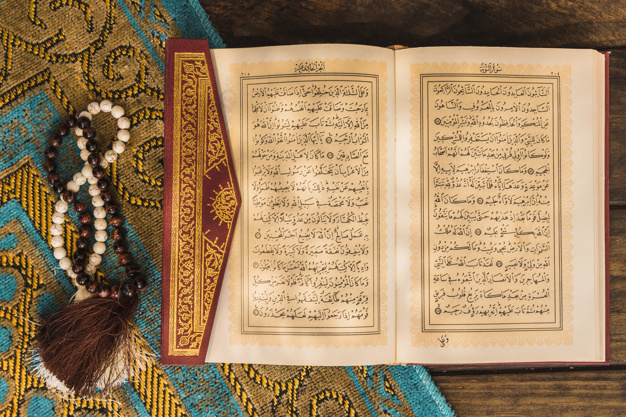
The Qur’an is a Message from Allah to humanity. It was transmitted to us in a chain starting from the Almighty Himself to the angel Gabriel to the Prophet Muhammad [pbuh]. This message was given to the Prophet [pbuh] in pieces over a period spanning approximately 23 years [610 CE to 622 CE]. The Prophet [pbuh] was 40 years old when the Qur’an began to be revealed to him, and he was 63 when the revelation was completed. The language of the original message was Arabic, but it has been translated into many other languages.
The Qur’an is one leg of two which form the basis of Islam. The second leg is the Sunnah of the Prophet [pbuh]. What makes the Qur’an different from the Sunnah is primarily its form. Unlike the Sunnah, the Qur’an is quite literally the Word of Allah, whereas the Sunnah was inspired by Allah but the wording and actions are the Prophet’s. The Qur’an has not been expressed using any human’s words. Its wording is letter for letter fixed by no one but Allah.
Prophet Muhammad [pbuh] was the final Messenger of Allah to humanity, and therefore the Qur’an is the last Message which Allah has sent to us. Its predecessors such as the Torah, Psalms, and Gospels have all been superceded. It is an obligation – and blessing – for all who hear of the Qur’an and Islam to investigate it and evaluate it for themselves. Allah has guaranteed that He will protect the Qur’an from human tampering, and today’s readers can find exact copies of it all over the world. The Qur’an of today is the same as the Qur’an revealed to Muhammad [pbuh].
During the life of the Prophet [pbuh] [570-632 CE]
The Prophet [pbuh] used to recite the Qur’an before angel Gabriel [Gabriel] once every Ramadan, but he recited it twice [in the same order we have today] in the last Ramadan before his death. Gabriel also taught the Prophet [pbuh] the seven modes of recitation.
Each verse received was recited by the Prophet, and its location relative to other verses and Sūrahs was identified by him.
The verses were written by scribes, selected by the Prophet, on any suitable object – the leaves of trees, pieces of wood, parchment or leather, flat stones, and shoulder blades. Scribes included Ali Ibn Abi Talib, Mu’awiyah Ibn Abi Sufyan, Ubey Ibn Ka’ab, Zayed Ibn Thabit.
Some of the companions wrote the Qur’an for their own use.
Several hundred companions memorized the Qur’an by heart.
During the caliphate of Abu Bakr [632-634 CE]
Umar Ibn Al-Khattab urged Abu Bakr to preserve and compile the Qur’an. This was prompted after the battle of Yamamah, where heavy casualties were suffered among the reciters who memorized the Qur’an.
Abu Bakr entrusted Zayed Ibn Thabit with the task of collecting the Qur’an. Zayed had been present during the last recitation of the Qur’an by the Prophet to Angel Jibreel [Gabriel].
Zayed, with the help of the companions who memorized and wrote verses of the Qur’an, accomplished the task and handed Abu Bakr the first authenticated copy of the Qur’an. The copy was kept in the residence of Hafsah, daughter of Umar and wife of the Prophet.
During the caliphate of Uthman [644-656 CE]
Uthman ordered Zayed Ibn Thabit, Abdullah Ibn Al Zubayr, Saeed Ibn Al-Aas, and Abdur-Rahman Ibn Harith Ibn Hisham to make perfect copies of the authenticated copy kept with Hafsa. This was due to the rapid expansion of the Islamic state and concern about differences in recitation.
Copies were sent to various places in the Muslim world. The original copy was returned to Hafsa, and a copy was kept in Madinah.
Three stages of dotting and diacritization
Dots were put as syntactical marks by Abu Al-Aswad Al Doaly, during the time of Mu’awiya Ibn Abi Sufian [661-680 CE].
The letters were marked with different dotting by Nasr Ibn Asem and Hayy ibn Ya’amor, during the time of Abd Al-Malek Ibn Marawan [685-705 CE].
A complete system of diacritical marks [damma, fataha, kasra] was invented
